A car stopped on the hard shoulder is uncomfortable and, more to the point, unsafe. In Santa Cruz de Tenerife we take breakdown calls at any hour of the day or night, with flatbed vehicles that move the car without putting any further strain on it and without adding kilometres to an engine that is already in trouble.
Every move to or from Santa Cruz de Tenerife includes a sea leg, and that changes planning completely. It is not simply a matter of adding hours: collection has to fit the sailing schedule, space has to be booked, and a cancellation due to rough seas delays the whole chain.
What makes Santa Cruz de Tenerife different
It helps to set the context before going into detail. Moves to or from Tenerife combine road and sea legs, with timings tied to sailing frequency. Mount Teide shapes the road network, with big height differences between the north and south of the island.
Inter-island movement runs on frequent short-crossing ferries. There is more background on the city in its Wikipedia entry.
What actually fails at the roadside
By frequency, batteries strand more cars than anything else, followed by starting faults, engine overheating, punctures with no usable spare, and clutch or transmission failures. Modern electronics add a growing category of sensor faults that drop the car into limp mode.
Some of these can be fixed on the spot and some cannot. A flat battery can be jump-started; an engine that has lost coolant and overheated must not be restarted under any circumstances, because every further minute of running deepens damage that may already be irreversible.
Transport insurance: the question always worth asking
Before handing keys to anyone, ask one specific question: is the vehicle covered while it sits on the transporter, for how much, and against what. An operator working legally and registered with the Spanish Ministry of Transport can evidence that without difficulty.
The carrier's cover is not the same as your own motor policy. Your insurance covers driving; during transport it is the carrier's goods-in-transit policy that responds. Confusing the two is behind most of the disputes that arise.
The legal position: when transport stops being optional
A vehicle without a valid ITV, without insurance, or on temporary deregistration cannot legally be driven on public roads. The Dirección General de Tráfico (DGT) is unambiguous here, and the penalty falls on the registered keeper. Moving it by truck is not a matter of preference — it is the only lawful option.
Royal Decree 920/2017 governing the ITV roadworthiness test sets out the narrow circumstances in which a vehicle may travel to a test station, and outside that specific case driving it is prohibited. That distinction is worth understanding before assuming you can drive to the garage.
In Santa Cruz de Tenerife it makes sense to confirm the sailing date before committing to anything that depends on the vehicle arriving.
Before you call anyone
The most common mistake after a breakdown is staying inside the vehicle on a motorway hard shoulder, statistically one of the more dangerous places you can be. Mark the vehicle, get out on the side away from traffic, and stand behind the crash barrier.
With the situation made safe, you can assess the problem. Note any warning lights that appeared before you stopped, along with any noises, smells or smoke — that information speeds up the diagnosis considerably when we arrive.
A recovery quote, broken down
Price depends on the distance between collection and destination, the vehicle type, how difficult the access is, and the time of day. A night or public holiday call-out costs more, for obvious reasons of availability.
What should not happen is unannounced extras appearing at the end. Charges for awkward access, for a non-rolling vehicle, or for out-of-hours work belong in the original quote.
Electric and hybrid vehicle breakdowns
The share of electric and hybrid vehicles on the road grows every year, and call-outs involving them grow with it. The main practical difference is that these vehicles must always travel on a flatbed, without exception, and that securing points must respect the location of the battery pack.
The destination changes too. A broken-down EV cannot go to just any garage — it needs an authorised workshop with high-voltage trained technicians, and that is worth confirming before agreeing a delivery point.
Flatbed transport versus conventional towing
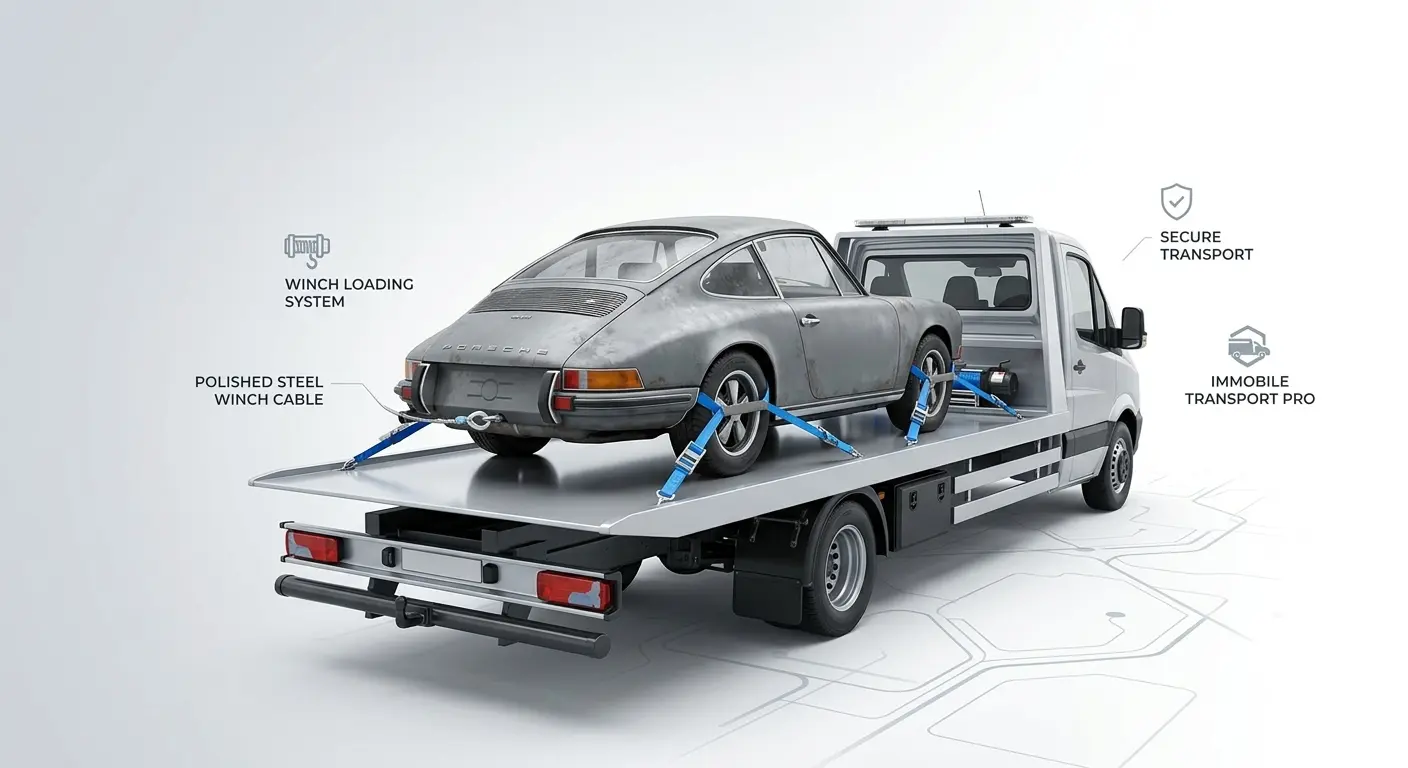
A flatbed carries the whole vehicle on the deck with all four wheels off the ground. That removes tyre wear, spares the transmission a rotation it was never designed for while stationary, and avoids damage to whichever axle would otherwise be rolling.
On vehicles with automatic gearboxes, four-wheel drive or electronic traction systems, a flatbed is not a preference but a manufacturer requirement. Towing with driven wheels in contact with the road can cause serious drivetrain damage.
The line between carrying on and stopping
Four signals mean switch off and do not try again: the oil pressure light, the temperature gauge in the red, a new internal metallic noise, and any smell of burning. In those situations transport is not a convenience — it is how you limit the damage.
Overheating deserves separate mention. An engine that has run without sufficient coolant may have distorted the cylinder head, and restarting it to cover a few kilometres to the garage can turn a manageable repair into a full engine replacement.
Other services in Santa Cruz de Tenerife
Breakdown recovery in other cities
There is more detail on breakdown recovery, the full list on our services page, and you can reach us through contact for an assessment of your situation in Santa Cruz de Tenerife.
Details worth keeping in mind
Flag it if the vehicle has stood unused for a long period. Flat tyres, seized brakes or a completely dead battery all change how it has to be loaded.
Before the truck arrives, take the documentation, spare keys and anything valuable out of the vehicle. It travels unaccompanied, and items left inside are not covered as luggage.
Know where the spare wheel and tools are if the vehicle carries them. On long moves, a loose item in the boot shifts during the journey and can damage the interior or the trim.
Make sure the alarm is disabled, or that the driver knows how to disable it. An alarm going off in transit means stopping and complicates the job for no reason.
Keep the job reference or delivery note. If you later need to evidence the move to an insurer, a workshop or the authorities, that document proves when and how the vehicle was moved.
On keyless-start vehicles, remember the fob must travel with you or be handed over at the destination, but never left inside the car in transit. It is a more common oversight than you would think and leaves the vehicle locked on arrival.
Be wary of quotes well below market rate. In vehicle transport, a low price usually means no goods-in-transit insurance, no operating authorisation, or neither.
If you will not be present at collection or delivery, put in writing who hands over and who receives the keys, with a phone number. This is the single most common cause of avoidable delay.
If the move is a private sale, coordinate payment and key handover clearly. The carrier moves the vehicle; it takes no part in the transaction.
In low-emission zones, verify whether the transport truck can enter during the planned time window. Many restrictions apply to heavy vehicles even where the car being carried would itself be allowed through.
An accessible collection point saves both time and money. If the street is narrow or the garage has restricted headroom, agreeing a nearby spot where the truck can manoeuvre simplifies everything.
For vehicles with bulky modifications or accessories — roof racks, bike carriers, bull bars — mention them. They can affect the overall height of the loaded truck and whether it clears certain access points.
Keep the job documentation recording the vehicle's condition. It is the reference point if a question about damage and its timing comes up later.
Get the name and number of the driver handling the job, or at least a direct operational contact. On the day, being able to resolve a question in two minutes prevents an hour of waiting.
Where a tailgate or bonnet no longer closes properly after an impact, secure it before loading. A tailgate that springs open at eighty kilometres an hour is a genuine hazard to other traffic.
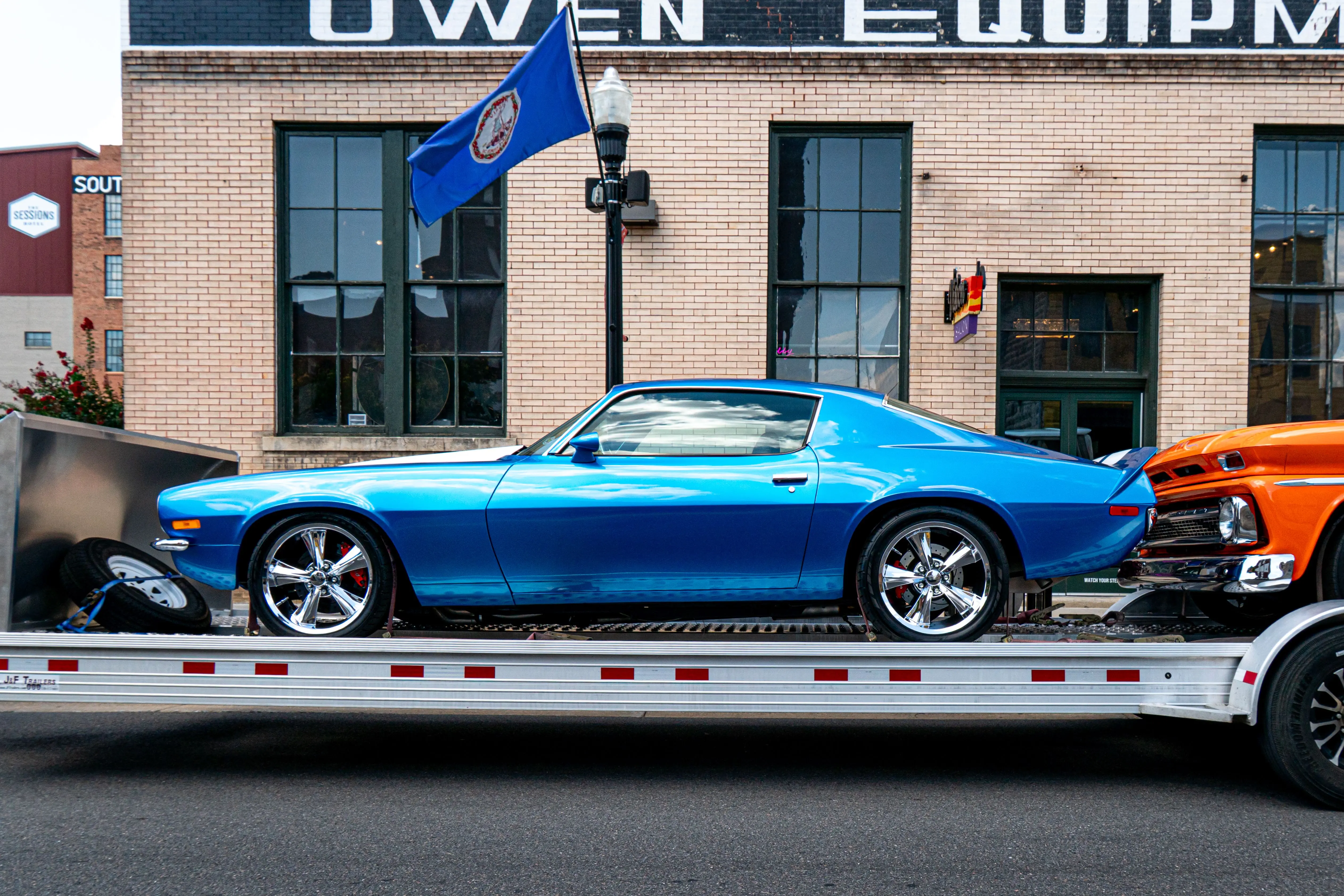
Open transporters are the standard option and perfectly safe for most vehicles. Enclosed transport makes sense for classics, high-value cars and anything with very low ground clearance.
Photograph the vehicle before loading, including all four corners, the roof and underneath if you can. It takes two minutes and settles any later disagreement about a scratch.
Ask whether the price includes waiting time at loading and unloading. On moves to workshops, dealerships or compounds with slow procedures, that time can stretch, and it is worth knowing in advance how it is counted.
Always ask whether the price covers collection and delivery at the points you need, or refers to a terminal-to-terminal move. The difference in cost and convenience is considerable.
If the vehicle is on rural land or at the end of an unsurfaced track, state the distance from the tarmac road. An articulated truck cannot enter every lane, and sometimes the car has to be brought out to a meeting point.
If you are selling the vehicle and the buyer arranges transport, put in writing when responsibility passes. It is normally at key handover, but both parties benefit from having it stated.
If the vehicle will sit on a public street waiting for collection, check there are no timed restrictions or scheduled clearing on that road. A car towed by the local authority while waiting for transport complicates matters considerably and adds costs nobody planned for.
On classic vehicles with carburettors or older systems, say whether the engine needs any particular starting procedure. If it has to be moved even a few metres, that information saves time.
Bear in mind that in peak periods — summer, or the start and end of the season — lead times stretch. Booking ahead is the simple way around it.
In summary
If you need a vehicle moved in Santa Cruz de Tenerife, the most useful thing is an assessment of your specific situation. We give you a total price and a realistic timescale, not a per-kilometre rate that grows later.
Need recovery in Santa Cruz de Tenerife?
One number, any hour. We tell you how long we will be and what it costs before we set off.