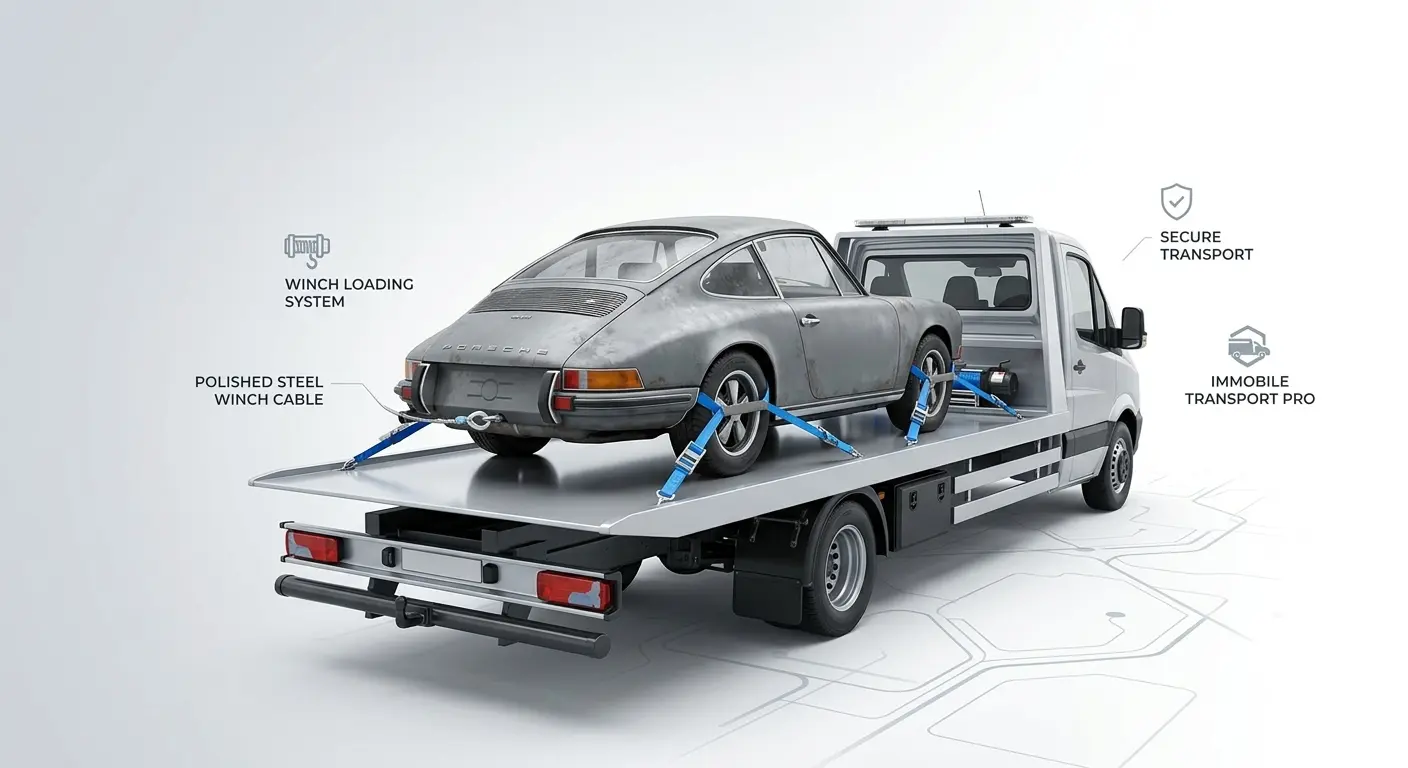
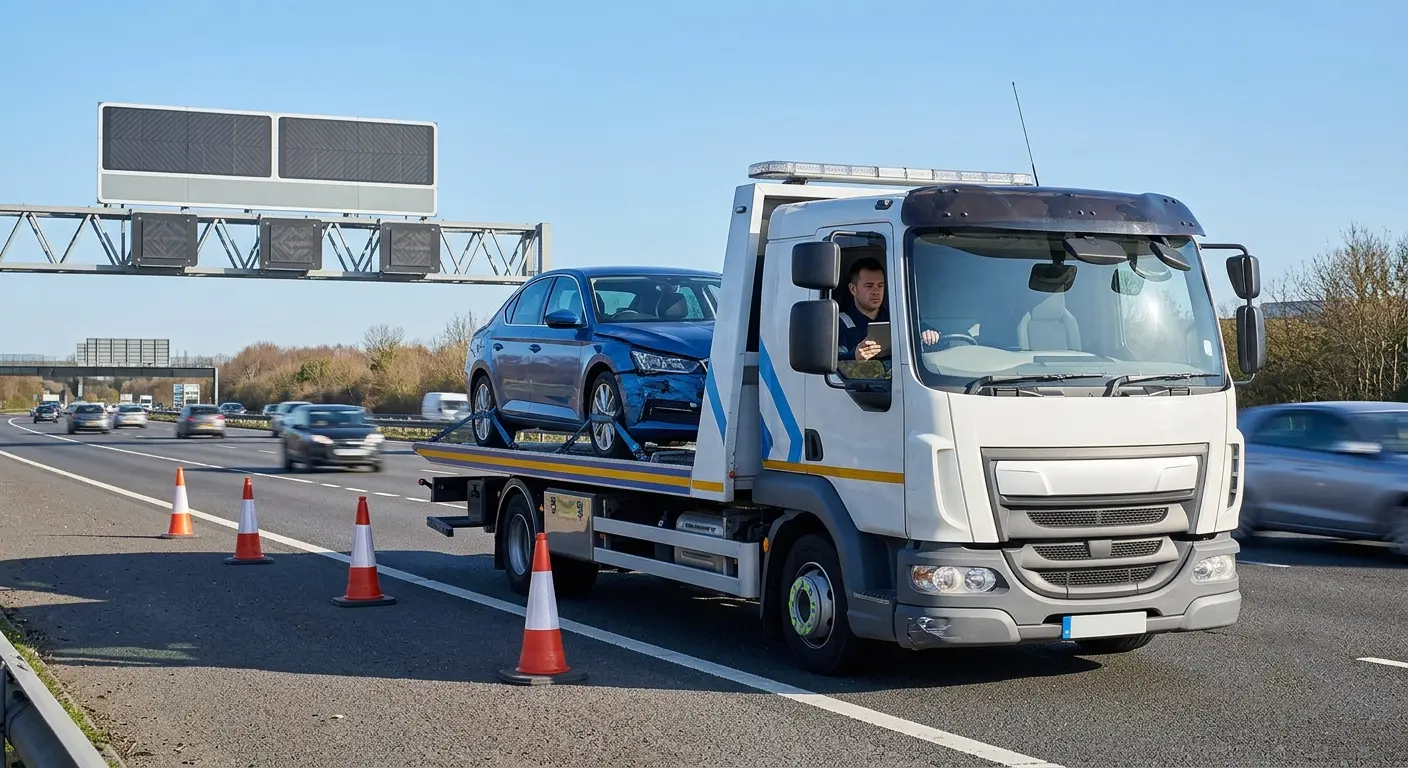
We work in Ibiza on a simple principle: arrive when we say we will, and take the vehicle to the garage you choose. No imposed destinations and no extras appearing at the end. Flatbed recovery, goods-in-transit cover for the journey, and a fixed price from the first call.
A vehicle leaving Ibiza for the mainland travels under two different transport modes with two different liability regimes. It is worth being clear from the outset about who covers what on each leg, and what documentation travels with the vehicle.
Moving a vehicle in Ibiza: what to know
Ibiza is a regular destination for our work, and it comes with conditions of its own. Ibiza's pronounced seasonality concentrates vehicle moves around the start and end of the season. Ferry capacity tightens in peak months, so sailings are worth booking well ahead.
The streets of Dalt Vila and the old town are exceptionally narrow.
How a broken-down car should travel
A flatbed carries the whole vehicle on the deck with all four wheels off the ground. That removes tyre wear, spares the transmission a rotation it was never designed for while stationary, and avoids damage to whichever axle would otherwise be rolling.
On vehicles with automatic gearboxes, four-wheel drive or electronic traction systems, a flatbed is not a preference but a manufacturer requirement. Towing with driven wheels in contact with the road can cause serious drivetrain damage.
Should I call my insurer or arrange it myself?
Assistance included in your policy covers many situations and is worth using when it applies. But it has limits that catch people out: a maximum towing distance, a destination fixed to the nearest approved garage, exclusion of vehicles without a valid ITV, and on some policies a capped number of call-outs per year.
Booking direct makes sense when you want to choose the destination garage, when the distance exceeds what the policy covers, when the vehicle has no valid ITV, or when the waiting time offered is simply not acceptable.
What determines the price of a recovery
Price depends on the distance between collection and destination, the vehicle type, how difficult the access is, and the time of day. A night or public holiday call-out costs more, for obvious reasons of availability.
What should not happen is unannounced extras appearing at the end. Charges for awkward access, for a non-rolling vehicle, or for out-of-hours work belong in the original quote.
Sailing availability from Ibiza varies considerably through the year, and in summer it can determine the delivery date more than any other factor.
Transport insurance: the question always worth asking
Before handing keys to anyone, ask one specific question: is the vehicle covered while it sits on the transporter, for how much, and against what. An operator working legally and registered with the Spanish Ministry of Transport can evidence that without difficulty.
The carrier's cover is not the same as your own motor policy. Your insurance covers driving; during transport it is the carrier's goods-in-transit policy that responds. Confusing the two is behind most of the disputes that arise.
What changes when the car is electric
A broken-down electric vehicle has requirements of its own. It cannot be towed with driven wheels on the ground, because the motor would spin as a generator, and any handling has to respect the high-voltage system, which operates at genuinely dangerous voltages.
If the call-out is simply a depleted traction battery, the vehicle will not move under its own power and flatbed transport is the normal procedure. If there is any sign of battery damage — smell, smoke or deformation — the situation changes completely and needs a specific protocol.
Common breakdowns that end in recovery
By frequency, batteries strand more cars than anything else, followed by starting faults, engine overheating, punctures with no usable spare, and clutch or transmission failures. Modern electronics add a growing category of sensor faults that drop the car into limp mode.
Some of these can be fixed on the spot and some cannot. A flat battery can be jump-started; an engine that has lost coolant and overheated must not be restarted under any circumstances, because every further minute of running deepens damage that may already be irreversible.
What the law says about moving a vehicle that cannot be driven
Driving without a current ITV carries a fine and can result in the vehicle being immobilised under the rules the Dirección General de Tráfico (DGT) enforces. There is a larger problem behind it: in the event of an accident, your insurer may reduce or refuse cover entirely.
Royal Decree 920/2017 governing the ITV roadworthiness test allows a limited exception for travelling to a booked inspection, but it does not permit normal use of the vehicle. Any other journey requires it to be carried on a transporter.
Before you call anyone
The most common mistake after a breakdown is staying inside the vehicle on a motorway hard shoulder, statistically one of the more dangerous places you can be. Mark the vehicle, get out on the side away from traffic, and stand behind the crash barrier.
With the situation made safe, you can assess the problem. Note any warning lights that appeared before you stopped, along with any noises, smells or smoke — that information speeds up the diagnosis considerably when we arrive.
Other services in Ibiza
Breakdown recovery in other cities
More on breakdown recovery and on the rest of our services. If you would rather we called you, leave your details on the contact page and we will assess your case in Ibiza.
Details worth keeping in mind
Check the handbrake works and that the vehicle can be secured on the deck. If it cannot, there are solutions, but it is better known in advance.
If the vehicle will sit on a public street waiting for collection, check there are no timed restrictions or scheduled clearing on that road. A car towed by the local authority while waiting for transport complicates matters considerably and adds costs nobody planned for.
Bear in mind that in peak periods — summer, or the start and end of the season — lead times stretch. Booking ahead is the simple way around it.
Know where the spare wheel and tools are if the vehicle carries them. On long moves, a loose item in the boot shifts during the journey and can damage the interior or the trim.
If the vehicle has any quirk — lowered suspension, an automatic gearbox locked in park, a flat battery — mention it when requesting the quote so the right equipment turns up.
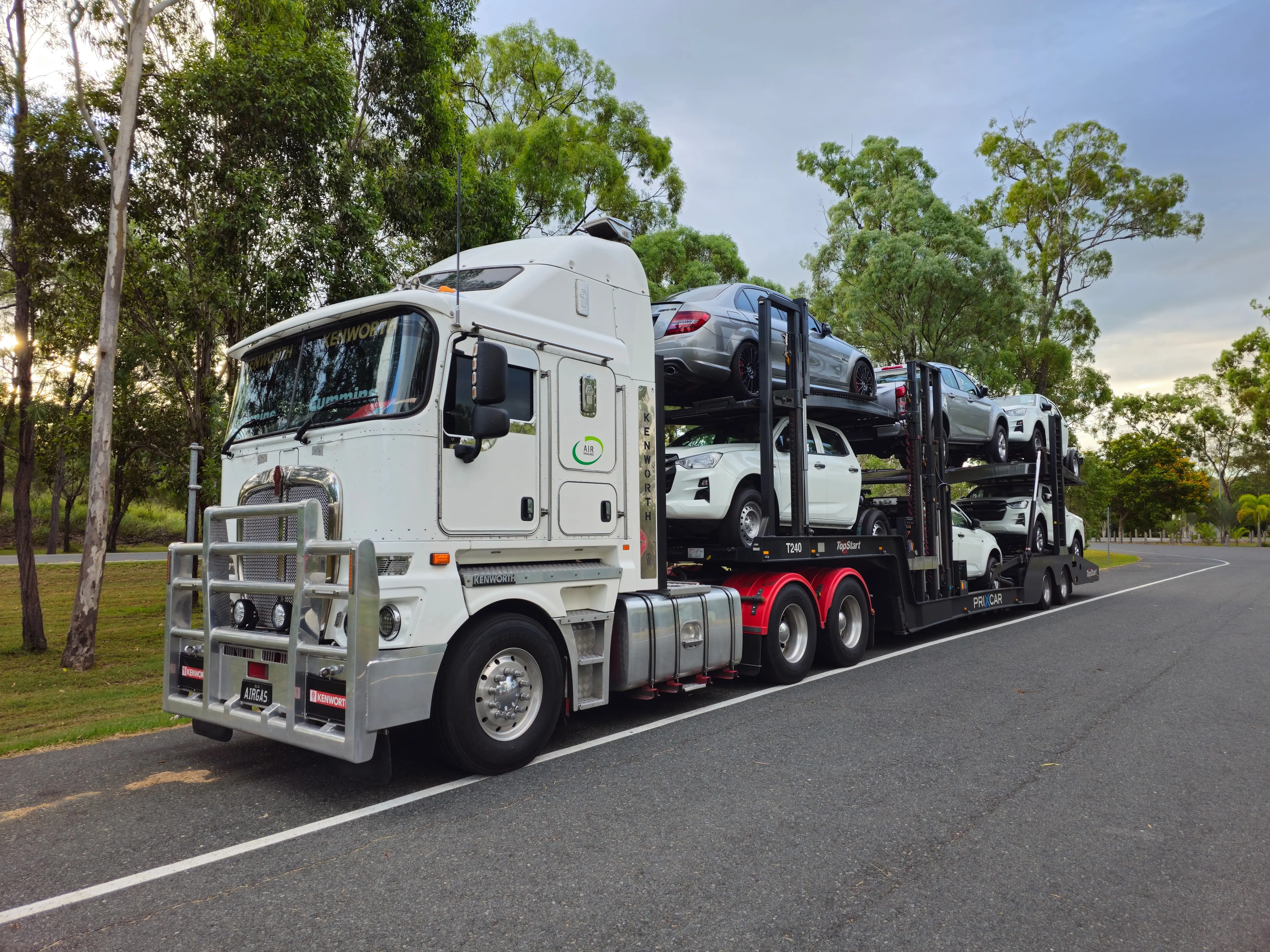
Moving several vehicles together usually works out considerably cheaper per unit than separate jobs. If you have more than one to move, it is worth quoting them as one.
If the move is a private sale, coordinate payment and key handover clearly. The carrier moves the vehicle; it takes no part in the transaction.
If the vehicle has been in an accident, say what is damaged and whether the wheels still turn. A vehicle that will not roll needs a winch and sometimes dollies.
On moves crossing several autonomous communities, bear in mind that heavy vehicle driving restrictions vary at weekends and on public holidays. That can affect the specific delivery day.
On keyless-start vehicles, remember the fob must travel with you or be handed over at the destination, but never left inside the car in transit. It is a more common oversight than you would think and leaves the vehicle locked on arrival.
In low-emission zones, verify whether the transport truck can enter during the planned time window. Many restrictions apply to heavy vehicles even where the car being carried would itself be allowed through.
Agree who signs for the vehicle at the destination. If it arrives at a closed workshop or an address where nobody is present, the driver cannot simply leave it, and waiting time or a second attempt both cost money.
On vehicles with large-diameter wheels and low-profile tyres, the approach to the ramps needs more care. It is worth mentioning so the right angle is prepared and the tyre or rim is not scuffed.
If the move includes a sea crossing, check what documentation the ferry operator requires for the vehicle. The registration document and owner details are usually needed, and a missing paper means missing the sailing.
If the collection is from a building with a communal garage, tell the manager or concierge. A transporter manoeuvring on a shared ramp without warning creates avoidable friction with neighbours.
Be wary of quotes well below market rate. In vehicle transport, a low price usually means no goods-in-transit insurance, no operating authorisation, or neither.
Keep the job reference or delivery note. If you later need to evidence the move to an insurer, a workshop or the authorities, that document proves when and how the vehicle was moved.
Have the vehicle and ownership documents ready. On moves ending at a port terminal or crossing a border, that paperwork matters as much as the vehicle itself.
Before collection, check no personal documents are left in the glovebox. It is where forgotten paperwork most often turns up, and some of it contains details you would not want travelling unsupervised.
Ask whether the price includes waiting time at loading and unloading. On moves to workshops, dealerships or compounds with slow procedures, that time can stretch, and it is worth knowing in advance how it is counted.
Where a tailgate or bonnet no longer closes properly after an impact, secure it before loading. A tailgate that springs open at eighty kilometres an hour is a genuine hazard to other traffic.
If the vehicle is in an underground car park, check the clearance height first. Many garages cannot take a transporter and the car has to be brought up to street level.
Flag it if the vehicle has stood unused for a long period. Flat tyres, seized brakes or a completely dead battery all change how it has to be loaded.
On long moves, asking how many loading and unloading points the truck has helps explain the timescale. A truck making several stops takes longer than a direct run.
Get the name and number of the driver handling the job, or at least a direct operational contact. On the day, being able to resolve a question in two minutes prevents an hour of waiting.
In summary
If you need a vehicle moved in Ibiza, the most useful thing is an assessment of your specific situation. We give you a total price and a realistic timescale, not a per-kilometre rate that grows later.
Need recovery in Ibiza?
We operate 24 hours a day. Tell us where you are and what has happened, and we will give you a price and a time.