There is a widespread misunderstanding about what you can do with a car whose ITV has lapsed. The exception for travelling to a booked test does exist, but it is narrow and does not permit normal use. In Jaén we handle the move so you do not have to rely on a doubtful interpretation.
In Jaén and its province the challenge is usually not the vehicle but reaching it. Scattered settlements, narrow secondary roads and uneven surfaces mean collection needs the right truck and sometimes bringing the vehicle out to an accessible point before loading.
What makes Jaén different
The province is large and olive-growing, with many rural tracks of uneven surface. The A-44 and A-4 are the main routes towards Granada and Madrid.
Jaén sits in hill country, with steeply graded streets in the upper part of the city. For general background on the area, the Jaén entry on Wikipedia covers the basics.
The journey to the inspection station
A vehicle that has stood for a long time and is going for its ITV usually has accumulated problems. Driving it to the station, even relying on the exception, can be a poor idea if the brakes or steering are not responding.
Transport to the station and, if it fails, on to the garage, is a routine service. It avoids penalties and avoids the risk of driving a vehicle whose actual condition is unknown.
The quote: the variables that count
Ask for a fixed quote and confirm it covers collection and delivery at the specific points you need. The difference between a door-to-door service and one between agreed points is significant in both cost and convenience.
On long-distance moves the cost per kilometre falls. If the vehicle has to cross the country, ask for the total rather than working from a per-kilometre rate.
What you risk by driving a non-compliant vehicle
Driving a few kilometres with an expired ITV feels like a minor risk, and in terms of the odds of being stopped it perhaps is. The problem is the asymmetry: the saving is the price of a transport job, and the potential loss has no defined ceiling.
There is also liability towards others. A vehicle that has not passed inspection may carry undetected safety defects, and if those contribute to an accident the driver's legal position becomes considerably worse.
In winter, access to some settlements around Jaén depends on the state of the mountain passes, and that can shift the planned date.
Special administrative situations
Administrative restrictions on a vehicle — seals, seizures or registry entries — limit what can be done with it. Checking the vehicle report before the move avoids unpleasant surprises.
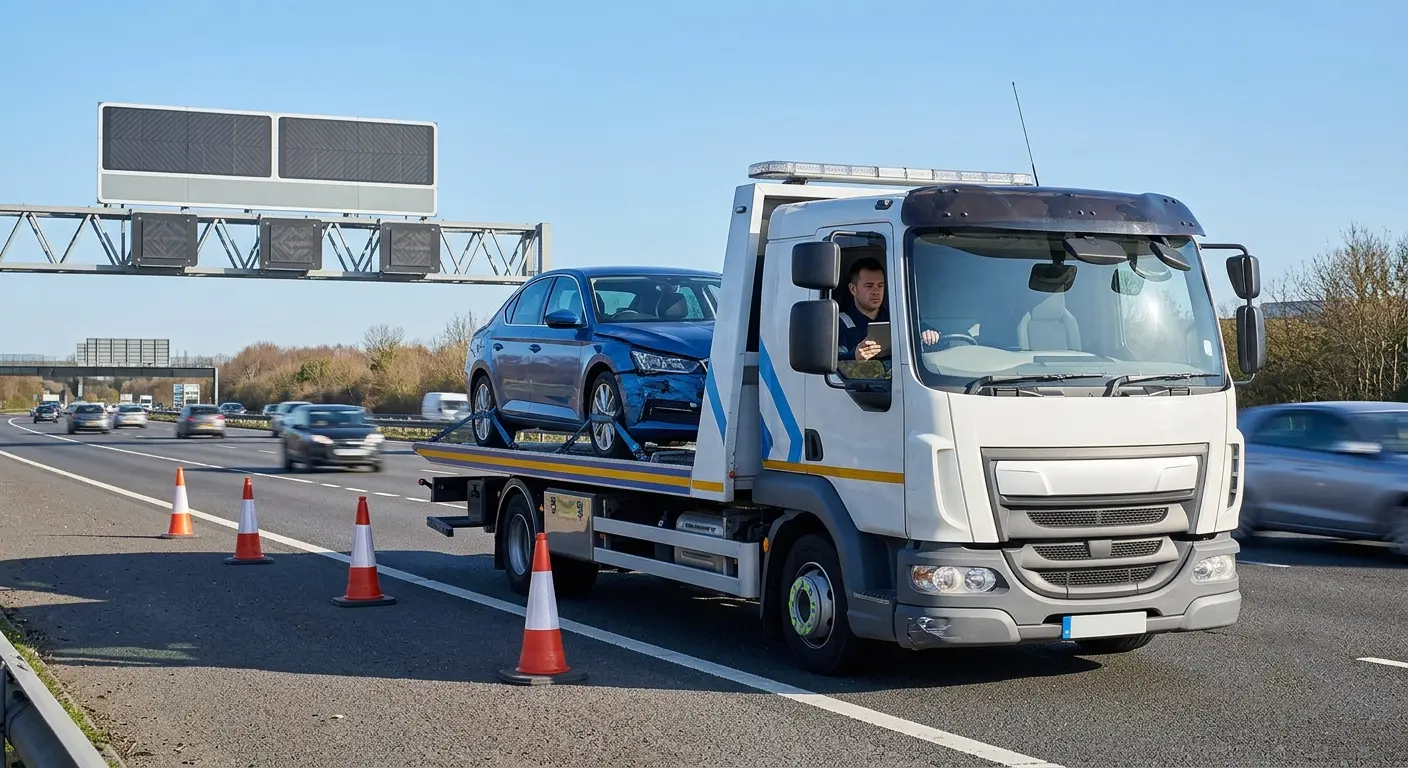
Once the situation is regularised and all that remains is getting the vehicle to a specific place, flatbed transport is the standard procedure.
No insurance in force: how to move it
Temporary deregistration is a useful option for vehicles that will not be used for a long period, but it means giving up the right to drive them. When the time comes to move the car, transport is the only lawful route.
It is worth checking the vehicle's administrative status before arranging the move. Knowing whether it is temporarily deregistered, permanently deregistered or simply without an ITV determines what formalities apply at the destination.
How your vehicle is covered while it is being moved
Cover is the detail most often skipped when booking a move. It is not enough for a company to say it is insured — the scope matters, and it should appear on the job documentation alongside the vehicle's condition at the point of loading.
Road haulage is a regulated activity requiring authorisation, overseen by the Spanish Ministry of Transport. An informal operator without authorisation or a transit policy simply shifts the whole risk onto the owner.
Regulations that apply to moving a vehicle
Spanish law draws a clear line between a vehicle fit for the road and one that is not. Where the ITV has lapsed, insurance has ended, or the vehicle is on temporary deregistration, driving it stops being legal and the Dirección General de Tráfico (DGT) can penalise it.
Beyond Royal Decree 920/2017 governing the ITV roadworthiness test, road transport of vehicles is subject to operating requirements overseen by the Spanish Ministry of Transport, including transport authorisation and goods-in-transit insurance.
Foreign residents and vehicles from abroad
A foreign-plated vehicle whose owner is permanently resident in Spain can fall into an irregular position if it is not registered within the deadline. That affects both the right to drive it and the validity of its insurance.
While registration is being sorted out, any necessary movement of the vehicle can be done by truck without committing an offence. It is the standard way of handling the transition period.
Other services in Jaén
More on non-road-legal vehicle transport and on the rest of our services. If you would rather we called you, leave your details on the contact page and we will assess your case in Jaén.
Things to check before booking
On classic vehicles with carburettors or older systems, say whether the engine needs any particular starting procedure. If it has to be moved even a few metres, that information saves time.
Make sure the alarm is disabled, or that the driver knows how to disable it. An alarm going off in transit means stopping and complicates the job for no reason.
On moves crossing several autonomous communities, bear in mind that heavy vehicle driving restrictions vary at weekends and on public holidays. That can affect the specific delivery day.
Check whether your own policy covers the vehicle while it sits at a third-party workshop or compound. It is a frequent gap between the end of transport and the start of repair, and worth clarifying.
Have the vehicle and ownership documents ready. On moves ending at a port terminal or crossing a border, that paperwork matters as much as the vehicle itself.
If the vehicle is in an underground car park, check the clearance height first. Many garages cannot take a transporter and the car has to be brought up to street level.
Leave the fuel tank low, around a quarter. It reduces weight, follows standard transport practice, and there is nothing to gain from a full tank during the journey.
If you will not be present at collection or delivery, put in writing who hands over and who receives the keys, with a phone number. This is the single most common cause of avoidable delay.
In low-emission zones, verify whether the transport truck can enter during the planned time window. Many restrictions apply to heavy vehicles even where the car being carried would itself be allowed through.
Check the overall height if the vehicle is a van, a camper or a 4x4 with roof accessories. The vehicle's height plus the deck height determines what the loaded truck can pass under.
If the vehicle contains fuel cans or any flammable material, remove it beforehand. Dangerous goods transport is governed by its own regulations and cannot travel mixed in with the vehicle.
Bear in mind that in peak periods — summer, or the start and end of the season — lead times stretch. Booking ahead is the simple way around it.
On long moves, asking how many loading and unloading points the truck has helps explain the timescale. A truck making several stops takes longer than a direct run.
Get the name and number of the driver handling the job, or at least a direct operational contact. On the day, being able to resolve a question in two minutes prevents an hour of waiting.
Agree who signs for the vehicle at the destination. If it arrives at a closed workshop or an address where nobody is present, the driver cannot simply leave it, and waiting time or a second attempt both cost money.
A vehicle leaking oil or fuel should be flagged before transport. It does not prevent the move, but it affects where the car sits on the deck and what protection goes underneath it.
Moving several vehicles together usually works out considerably cheaper per unit than separate jobs. If you have more than one to move, it is worth quoting them as one.
If the collection is from a building with a communal garage, tell the manager or concierge. A transporter manoeuvring on a shared ramp without warning creates avoidable friction with neighbours.
Keep the job documentation recording the vehicle's condition. It is the reference point if a question about damage and its timing comes up later.
If the vehicle will sit on a public street waiting for collection, check there are no timed restrictions or scheduled clearing on that road. A car towed by the local authority while waiting for transport complicates matters considerably and adds costs nobody planned for.
On vehicles with large-diameter wheels and low-profile tyres, the approach to the ramps needs more care. It is worth mentioning so the right angle is prepared and the tyre or rim is not scuffed.
If the vehicle is on rural land or at the end of an unsurfaced track, state the distance from the tarmac road. An articulated truck cannot enter every lane, and sometimes the car has to be brought out to a meeting point.
Keep the job reference or delivery note. If you later need to evidence the move to an insurer, a workshop or the authorities, that document proves when and how the vehicle was moved.
An accessible collection point saves both time and money. If the street is narrow or the garage has restricted headroom, agreeing a nearby spot where the truck can manoeuvre simplifies everything.
Ask whether the price includes waiting time at loading and unloading. On moves to workshops, dealerships or compounds with slow procedures, that time can stretch, and it is worth knowing in advance how it is counted.
On keyless-start vehicles, remember the fob must travel with you or be handed over at the destination, but never left inside the car in transit. It is a more common oversight than you would think and leaves the vehicle locked on arrival.
If you are selling the vehicle and the buyer arranges transport, put in writing when responsibility passes. It is normally at key handover, but both parties benefit from having it stated.
In summary
In short: in Jaén what makes the difference is a realistic timescale, a fixed price with no extras, and a move documented from start to finish. That is exactly what we provide, at any hour.
Vehicle not road legal in Jaén?
To the test centre, the garage or an authorised treatment facility. We handle the move, you handle the paperwork.